
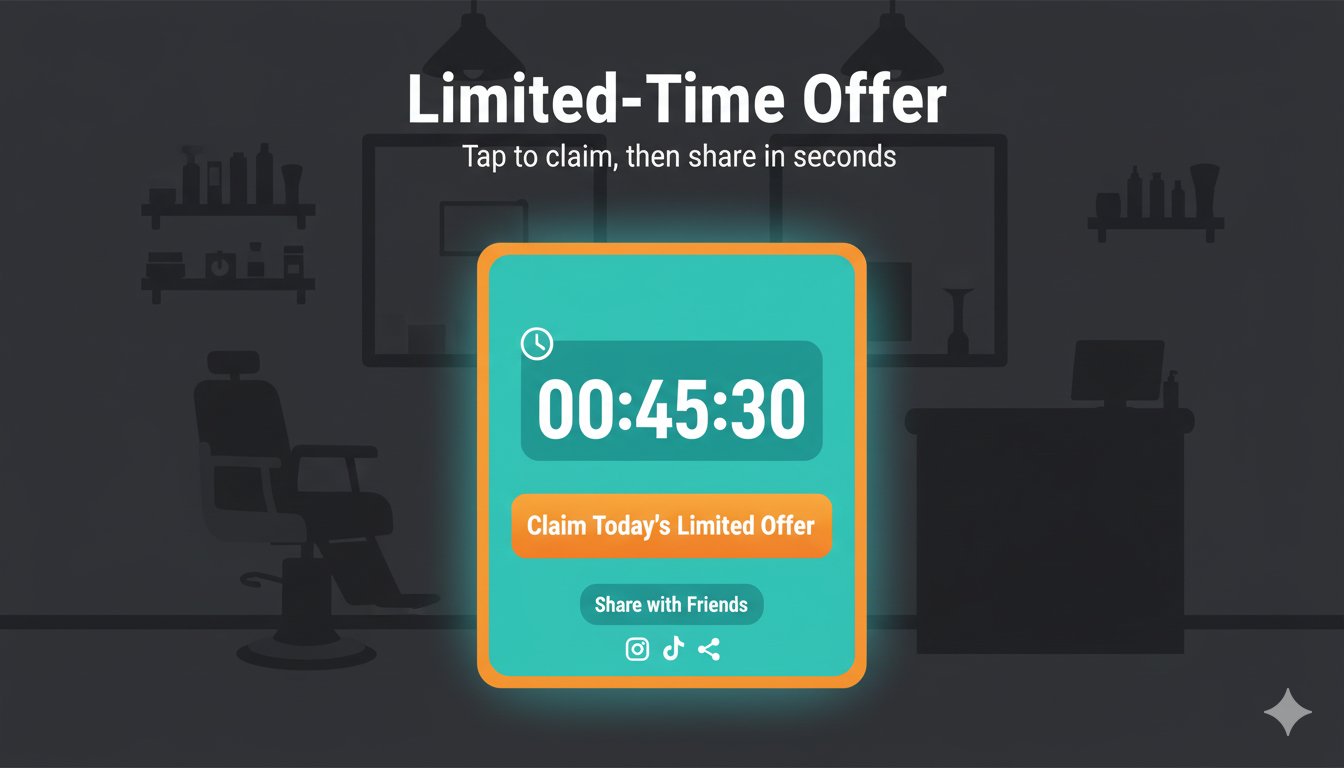
Limited‑time offers create urgency, but most stores underuse them at the point of service. With NFC + AI, you can let customers tap to claim a deal and instantly share with friends, multiplying reach and redemptions—fully tracked.
Table of contents
- Why Limited‑Time Offers + Share with Friends Works
- Core Value: From Static Promos to One‑Tap Growth
- Implementation: Methods, Steps, and Measurement
- Configure actions and placements
- Launch checklist
- Pitfalls to avoid
- What to measure
- Tapget Mapping: Actions by Scenario
- Compliance: Reviews, Incentives, Privacy, and UX
- Mini Case & In‑Store Scripts
- FAQ
- CTA
Why Limited‑Time Offers + Share with Friends Works
Urgency and social proof accelerate decisions. A time‑boxed offer converts in the moment; share with friends extends reach beyond your premises. Tapget makes both one‑tap actions—claim the offer, then share—reducing friction and boosting redemption and referrals.
Core Value: From Static Promos to One‑Tap Growth
- Pain points: Unseen posters, low coupon redemption, weak referrals, hard‑to‑track promos, and inconsistent staff prompts.
- Solution framework: Place NFC cards or printable QR at high‑intent spots—cashier counter, tables/waiting areas, window/posters, receipts/delivery packaging—routing to one‑tap actions: limited‑time offers, share with friends, follow social, memberships, buy deals, lucky draw, WiFi connect, reorder, and optional Google/Yelp review prompts (neutral).
- Quantifiable lift: Example baseline 50 customers/day; 15% tap the offer; 20% redeem; AOV 25 → ≈ 1,125/month incremental revenue from LTO redemptions alone, plus referrals and follows.
Implementation: Methods, Steps, and Measurement
Configure actions and placements
- Cashier counter: Tap‑to‑claim limited‑time offer; optional tap‑to‑follow; tap‑to‑share with friends.
- Tables / waiting areas / fitting rooms: One‑tap offer claim; self‑ordering add‑ons; lucky draw; WiFi connect.
- Window / posters / banner stands: Tap‑to‑follow; tap‑to‑share; subscribe to events; teaser for time‑boxed deals.
- Receipts / delivery packaging: Reorder link; claim next‑visit LTO; share with friends; add staff contact.
Launch checklist
- Define the deal: Choose a clear, time‑boxed offer (e.g., “Today only: 20% off add‑on service” or “48‑hour flash: Buy 1, Gift 1 to a friend”).
- Configure Tapget hub: Set up LTO page (countdown, terms), add share‑with‑friends button, social follows, and optional membership signup.
- Tag placements: Add per‑placement IDs/UTMs for counter/table/poster/delivery to compare performance.
- Train staff: A 10‑second prompt at checkout; point waiting‑area customers to the table card; keep scripts neutral for any review prompts.
- Test & iterate: A/B test headlines (“Claim now” vs. “Unlock today’s deal”), button order, and time windows (24–72 hours).
Pitfalls to avoid
- Vague or weak offers—be specific and time‑boxed.
- Incentivizing reviews (e.g., rewards for positive ratings) which violates platform rules.
- Long forms before claim/share; keep it a true one‑tap action.
- No attribution—without IDs/UTMs you can’t optimize placements.
- Poor signage or low contrast; customers miss the tap point.
What to measure
- Offer engagement: tap rate, claim rate, redemption rate, time‑to‑claim.
- Revenue impact: incremental sales from LTO, AOV changes, add‑on attachment.
- Referral: share‑with‑friends taps, invite sends, friend claims/redemptions.
- Audience growth: social follows from LTO and share flows; membership signups.
- Placement performance: counter vs. tables vs. posters vs. delivery packaging.
Tapget Mapping: Actions by Scenario
- Cashier counter:
- Limited‑time offers: claim in one tap at payment moment.
- Share with friends: send the deal instantly via message/social.
- Follow social: turn claims into followers.
- Tables / waiting areas:
- Self‑ordering add‑ons paired with LTO.
- Lucky draw/coupons to increase participation without tying to review ratings.
- WiFi connect with consent to capture contact for future deals.
- Window / posters:
- Share with friends, follow, subscribe to events to convert foot traffic.
- Receipts & delivery packaging:
- Claim next‑visit LTO, reorder, and share with friends post‑purchase.
All actions are trackable via per‑placement IDs to see which surfaces drive claims, shares, and redemptions.
Compliance: Reviews, Incentives, Privacy, and UX
- Review platforms (Google/Yelp): Do not reward positive ratings; use neutral language inviting honest feedback; allow customers to choose the platform.
- Offers & incentives: Keep offers independent of review content/rating; time‑box clearly; disclose terms and expiration.
- Privacy: For share/membership/WiFi, disclose data use, gain consent, provide opt‑out; collect minimal necessary data.
- UX best practices: Fast load, minimal steps, mobile‑first pages, visible countdown/timer, clear CTA labels, and platform‑appropriate deep links.
Mini Case & In‑Store Scripts
- Mini case: A neighborhood fitness studio added tap‑to‑claim limited‑time offers at the cashier counter and share with friends on posters. Over four weeks, claim rate hit 15%, redemptions 20%, adding ≈ 1,125 USD/month. Follows grew 28% and friend redemptions accounted for 35% of total LTO redemptions—tracked via placement IDs.
- Scripts:
- Offer claim (counter): “Tap here to unlock today’s limited offer—expires tonight.”
- Share prompt (poster): “Love this deal? Tap to share with a friend in two seconds.”
- Follow + membership (table): “Tap to follow and join members‑only deals—limited slots.”
FAQ
- What makes a limited‑time offer effective? Clear value, short expiry, and visible placement at the moment of decision.
- How does ‘share with friends’ work? A tap opens prefilled share options (message/social) with trackable links so you can attribute friend claims.
- Which placements convert best? Cashier counters usually drive claims; posters and delivery packaging drive shares; tables capture add‑ons and follows.
- Can I track ROI? Yes—measure tap/claim/redemption, referral claims, AOV, and placement performance with per‑placement IDs/UTMs.
- Will this slow checkout? No—keep the counter flow to a single tap; move secondary actions to posters/tables.
- Is this compliant with review rules? Yes—avoid rewarding positive ratings; keep any review ask neutral and separate from offers.
- Do I need to change my POS or website? Tapget complements existing systems with NFC/QR entry points and trackable one‑tap actions.
- What about privacy? Disclose data use for shares/memberships/WiFi, obtain consent, and offer opt‑out.
CTA
Configure Tapget, select limited‑time offers and share with friends as your primary actions, choose placements (cashier, tables, posters, delivery), and launch with tracking to prove fast, measurable growth.

Leave a Reply